This piece was featured in the summer issue of the yoga publication “Camel Magazine.”
It was a lovely day in late August in Minneapolis, Minnesota. The weather was starting to turn autumnal as the dog days of summer were cooling to a close. School had started for some students in the area; one Catholic school was in their first week back as they gathered in their chapel, kneeling to pray. It was at that time an assailant sprayed the beautiful stained glass windows with gunfire. Dozens of children would be injured, two wouldn’t live.
The phone in my pocket buzzed with a rare “Call me ASAP” message from my husband. I stepped out of my classroom into the bathroom, and in hushed tones I learned about the school shooting at Annunciation — a sister school to ours, right across the river. The images on the news were hard to swallow, children in green polo shirt uniforms identical to my son’s. After the shock, questions flooded my brain. Including the penultimate question: how would we, as a community, possibly cope with tragedy, and heal?
I’ve been reaching trauma-informed yoga since 2018. Now in a Master’s of Education program in trauma and resilience, and a newly minted Yoga4Sobriety instructor as well as a registered children’s yoga teacher, I am supposed to have some insights. I have been teaching yoga and mindfulness to young children for years now in area Catholic schools. I wrapped my training around me like a beloved child’s blanket, supposed to provide warmth and security, but in reality, it felt flimsy and worn.
There is a lot to know about trauma-informed yoga, whether it is childhood trauma, a recovering addict, complex community trauma, or all of the above. One thing I carry with me is an acronym that has always worked for me. I focus on LEAD-ing a class. I’ll explain.
L is for Language. In trauma-informed yoga, language is invitational, first and foremost. Not demanding. We invite students to join us, and offer suggestions for variations. This gives participants autonomy over their bodies and their practice, autonomy they may not be used to having. Also, we are cautious about certain terms. For instance, “positions” and “poses” can both have unintended sexual connotations. I prefer “postures;” some like “forms.”
E is for Environment. We always strive to create a safe, and welcoming environment. I like teaching my students in a circle, this removes any hierarchy. Watch out for overly darkened rooms or anything that might make a student nervous. Welcome them warmly, by name.
A is for Adjustments. Adjustments are verbal, not hands-on.
Finally, D is for Dedication. This is where class theme, and motivation for the class, come into play. In Yoga4Sobriety training, dedication may be a reading at the opening and closing of the class. In my religious schools, it may be prayer, or a short biblical affirmation to hold in their heart. A favorite of mine is derived from Psalm 46:10, “be still and know.” An entire class can be centered around “stillness” — asana practice, guided visualizations, mindfulness and breathing exercises, and quiet, brief moments of meditation with appropriate music.
Now, there will be some within certain communities, and there always are, that bristle at the term “yoga.” Some Christian leaders will say it is against their religious beliefs, and believers shouldn’t practice. For as old as yoga is — thousands of years — there are as many types of yoga as there are types of practitioners.
All conflict can be abated with education and open discussion. If you don’t discuss and utilize yoga philosophy and teachings, beyond the mind-body connection or connection of breath and yoga postures, then make that explicitly clear. I don’t use the word “yoga” on my business website or mission statement. I prefer “mindful movement.” It is inspired by, but not immersed in yoga asana practice, and utilizes the postures in appreciative (and not appropriative) ways. Universal themes like love and acceptance transcend religious denomination.
I met a Catholic woman once who told me yoga postures were each prayers to different Hindu gods. I gently explained that no, sometimes touching your toes is just touching your toes, and not bowing in prayer. Yoga comes from the Sanskrit word yuj, I told her, meaning “to yolk.” It refers more to mind and body connection, than any single Hindu god. She said, “we’ll agree to disagree.”
You will not change everyone’s mind.
Perhaps, however, that is not an honorable goal, even if you could.
I think only of how trauma-informed yoga and mindfulness training can benefit students. “Yoga is the cessation of fluctuations of the mind,” as the Yoga Sutras of Patanjali state (1.2). Yogas citta vritti nirodhah.
Vritti is a beautifully descriptive word that translates to “whirlpool,” or waves. These vritti disturb the citta (pronounced with a ch), from the root cit, meaning perception, or consciousness. How do we tame the whirlpools of the mind, but with stillness?
I feel we could all use a little more of that.
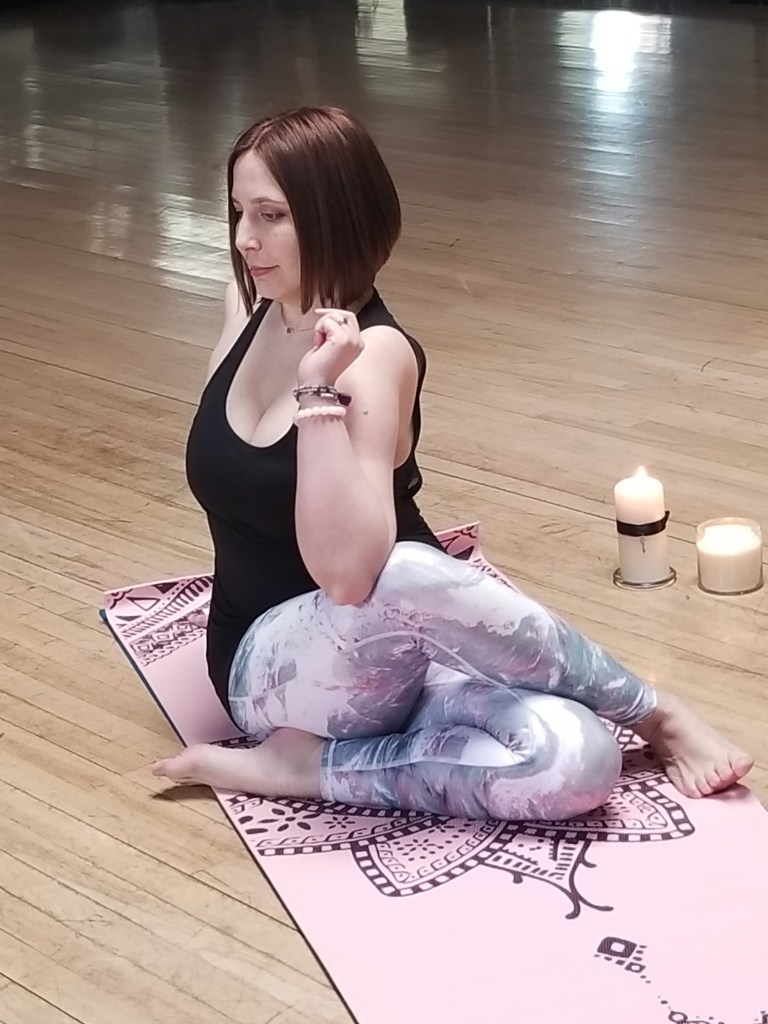
Julie Miller Grossman is the Founder and Director of the registered 501(c)(3) nonprofit, Still Kids. She is a Master’s student in Education with an Emphasis in Trauma and Resilience in Educational Settings, a Registered Children’s Yoga Teacher from the Trauma-Informed Yoga Psychology School, and a certified Yoga4Sobriety Instructor. She is an award-winning singer-songwriter and poet published in collaboration with the League of Minnesota Poets and the Rebel Loon Archive, and currently in the process of publishing her first children’s book, Domingo Flamingo. A devout Catholic, she also volunteers teaching children at her parish. She resides in Saint Paul with her husband, young son, and yorkie.

